Translated and Validated in ASL · Clinical Screening Tools

The Library of Established Clinical Assessments,
Translated and Validated in American Sign Language

Lexovia Health provides psychometrically validated ASL implementations of established health assessments, helping healthcare organizations improve accessibility while preserving the integrity of the original clinical instruments. This supports greater confidence that response data reflect clinical status rather than language barriers.

ASL ≠ English A fully distinct language with its own grammar, syntax, and structure that is not a form of English, nor Signed English
ADA Compliance Supports "effective communication" requirements under the ADA and Section 1557
More Accurate Data Assessments delivered in a patient's first language capture actual clinical status, not language comprehension failures
More Reliable Outcomes Improves confidence in patient-reported outcomes
Greater Access Built to expand equitable health care access for Deaf and Hard of Hearing patients

ASL Is a Distinct Language. Clinical Data Is More Accurate in ASL.

American Sign Language has its own grammar, syntax, and linguistic structure, entirely separate from English. It is not a visual code for English words, and treating it as one is where clinical communication with Deaf and Hard of Hearing patients breaks down.


Word-for-word translation distorts meaning. Many English clinical terms and idioms have no direct ASL equivalent. A literal sign-for-word rendering of a screening question can change what the patient is actually being asked.


Ad hoc interpretation introduces variability. When assessments are delivered through live interpreters or family members rather than a validated ASL version, every administration becomes a slightly different instrument, undermining standardization.


Comprehension errors can lead to misdiagnosis. When a screening question is not delivered in a patient's first language, their response may reflect a failure to understand rather than their true clinical status. That misunderstanding can be read as a clinical finding, leading to inaccurate diagnoses. Translated and validated ASL instruments eliminate this source of error by meeting patients in their own language.


It also strengthens ADA compliance. ADA Title II/III and Section 1557 of the ACA call for "effective communication," communication delivered with the same clarity and nuance afforded to hearing patients. A properly translated and validated ASL instrument can support effective communication obligations under the ADA and Section 1557.
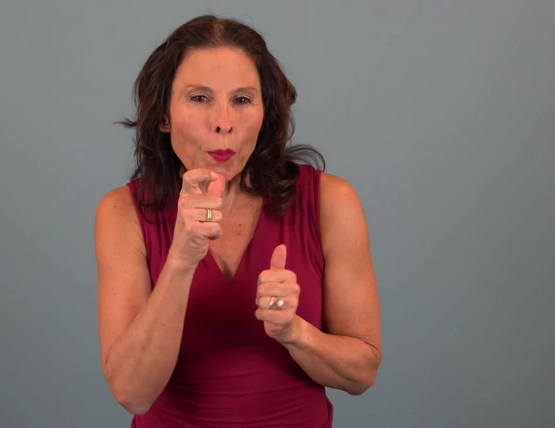
Melanie C. Nakaji, Ph.D.

The English question "Who is that?" is conveyed in American Sign Language through the coordinated use of manual signs and nonmanual grammatical markers. The signer first establishes the referent by pointing toward the individual ("that"), followed by the WH-sign WHO. Throughout the question, the signer produces the obligatory nonmanual markers associated with WH-questions, including furrowed eyebrows, a slight forward head position, and direct visual attention toward the referent. Importantly, the final WHO sign is held briefly at the end of the sentence. This hold, combined with the nonmanual markers, signals that the utterance is an interrogative rather than a statement. These nonmanual features are not optional embellishments; they are essential grammatical components that distinguish the intended meaning, "Who is that?", from other possible interpretations.


A Growing Library of ASL Translated and Validated Screening Instruments

We adapt established, widely used clinical screening tools, the same instruments health systems already rely on, into rigorously translated and validated ASL versions, organized by clinical domain. Every instrument is built to accurately serve Deaf and Hard of Hearing patients in their own language.

🧠

Behavioral & Mental Health Screening

Depression, anxiety, and general psychological distress screeners used across primary and behavioral health care.

🩺

Substance Use Assessment

Standardized screening tools for substance use, used at intake and throughout ongoing care.

🧩

Cognitive & Developmental Screening

Tools supporting early identification of cognitive and developmental concerns across the lifespan.

❤️

Chronic Disease & Functional Assessment

Instruments tracking chronic condition management, functional status, and pain.

📋

General Health Intake

Standardized intake and history instruments used at first point of contact with a health system.

📈

Outcomes & Quality Measures

Patient-reported outcome and quality measures health systems use for reporting and value-based care.

Every instrument in the library retains the scoring logic, structure, and intent of its original, validated source, adapted into ASL through the methodology below, not improvised at the point of care.

A Rigorous Standard for ASL Adaptation

Adapting a clinical instrument into another language is not translation, it is re-validation. Because ASL is a linguistically distinct language with its own grammar and structure, adapting any psychometrically validated instrument requires more than signing the words. Our process follows established cross-cultural test adaptation standards, applied specifically for ASL.

Each instrument begins with a structured forward and back translation process. A team of native ASL signers translates the original English instrument into ASL. That ASL version is then independently translated back into English by a separate team, and the two English versions are compared to identify any gaps in meaning, nuance, or clinical intent. Discrepancies are resolved through expert consensus before any item is finalized.

Once a consensus ASL version is established, it is administered to Deaf community members in a structured validation study. This phase evaluates whether the instrument performs psychometrically in ASL the way it does in English, including internal consistency, test-retest reliability, and convergent validity with established clinical measures.

This rigorous process is what distinguishes a validated instrument from an improvised one. Every instrument in the library is held to the same standard of equivalence before it reaches a clinical setting, because clinical decisions depend on the integrity of the data, not just the intent behind it.

This methodology is grounded in more than two decades of specialized research in psychometric instrument development for Deaf populations and ASL users. That depth of expertise includes the development of one of the first validated ASL proficiency assessment instruments, and is reflected in published peer-reviewed research across health psychology, behavioral health, health literacy, and healthcare communication. Every instrument in our library is held to the same standard: linguistically accurate, culturally responsive, and psychometrically sound.

Built for Clinical Deployment, Designed for Accurate Data

Translated and validated ASL instruments only create value when they fit into how care is actually delivered. We design every instrument to integrate directly into existing clinical workflows, with minimal disruption to how your team operates.

🔗 Workflow & Intake Integration

Instruments are structured to slot into existing intake, screening, and visit workflows for ease of deployment rather than requiring a separate process for Deaf patients.

🎥 Native ASL Administration

Patients complete assessments through ASL video or in-person administration, not a written English form, not an impromptu interpreter relay.

📊 Scoring Consistent With Source Norms

Because each instrument is psychometrically validated against its source, results are comparable to outcomes from the original English-language version, supporting consistent clinical decision-making across patient populations.

🗂️ Compliance Documentation

Administration is documented in a form that supports ADA and Section 1557 effective-communication compliance records, giving health systems a defensible record of how care was delivered.

👩‍⚕️ Staff Training & Onboarding

Clinical and front-desk staff receive guidance on administering and interpreting ASL-validated instruments correctly and consistently.

📚 Expanding Instrument Library

New instruments are added to the library on an ongoing basis, following the same validation methodology, so the library grows without compromising rigor.

Built Secure From the Ground Up

Clinical data deserves infrastructure-grade protection. Lexovia Health is designed to meet HIPAA requirements at every layer, from how data is stored to how it moves and who can touch it.

🔒

HIPAA-Compliant Infrastructure

Built on enterprise-grade, HIPAA-compliant cloud infrastructure, with signed Business Associate Agreements (BAAs) covering all handling of protected health information.

🛡️

Encryption at Rest

All stored data is encrypted using industry-standard AES-256 encryption, so data remains protected even at the storage layer.

🔐

Encryption in Transit

All data moving between patients, providers, and our platform is encrypted using TLS 1.2+, preventing interception in transit.

👤

Role-Based Access Control

Access to patient data is restricted by role and need, with multi-factor authentication required for all clinical and administrative accounts.

🧾

Full Audit Logging

Every access to patient data is logged, including who accessed it, when, and what action was taken, giving health systems a complete compliance record. These logs capture access activity only, not the clinical content of an assessment.

🧪

Resilient, Independently Tested Infrastructure

Patient data is stored with built-in redundancy across multiple secure facilities, and the platform undergoes regular third-party security assessments and penetration testing to identify and close gaps before they're exploited.

Built by People Who Know This Gap Firsthand

Megan Schwimmer

Megan Schwimmer

CEO

Megan Schwimmer brings more than two decades of experience spanning emergency and public safety communications, telecommunications, private sector management, and public sector operations, with a focus on implementation, communication, and workflow integration. Her experience across industries has shaped her understanding of how people interact with the services and systems designed to support them.

Through Lexovia Health, she helps organizations implement validated health assessments in ways that support trust, accessibility, and adoption within real world clinical workflows. Her work focuses on the gap between availability and adoption, particularly for historically underserved communities, because access is only the first step. Outcomes improve when solutions are designed to be used, trusted, and adopted.

Melanie Nakaji, Ph.D.

Melanie Nakaji, Ph.D.

Chief Research Officer

Melanie C. Nakaji, Ph.D. brings more than two decades of expertise in the translation, cultural adaptation, and psychometric validation of clinical instruments for Deaf populations and ASL users, with deep experience across every phase of the process, from forward and back translation through community validation, reliability testing, and validity analysis.

Her work spans behavioral health, health literacy, and patient-provider communication, and includes the development of one of the first validated ASL proficiency assessment instruments. Her research has appeared in peer-reviewed journals including the Journal of Health Psychology, Journal of Cancer Education, and Medical Education. Through Lexovia Health, she ensures every instrument meets the same standard: linguistically accurate, culturally responsive, and psychometrically sound.

Bring Translated and Validated ASL Clinical Assessments to Your Health Systems

Whether you're a health system, clinic, mental health platform, or any organization using clinical screening tools, we'd love to share what's currently available in the library and discuss what comes next. Our goal is simple: to help organizations extend the reach of validated assessments so more communities can benefit from them.